PRRT: radiation that finds its own target


PRRT: radiation that finds its own target
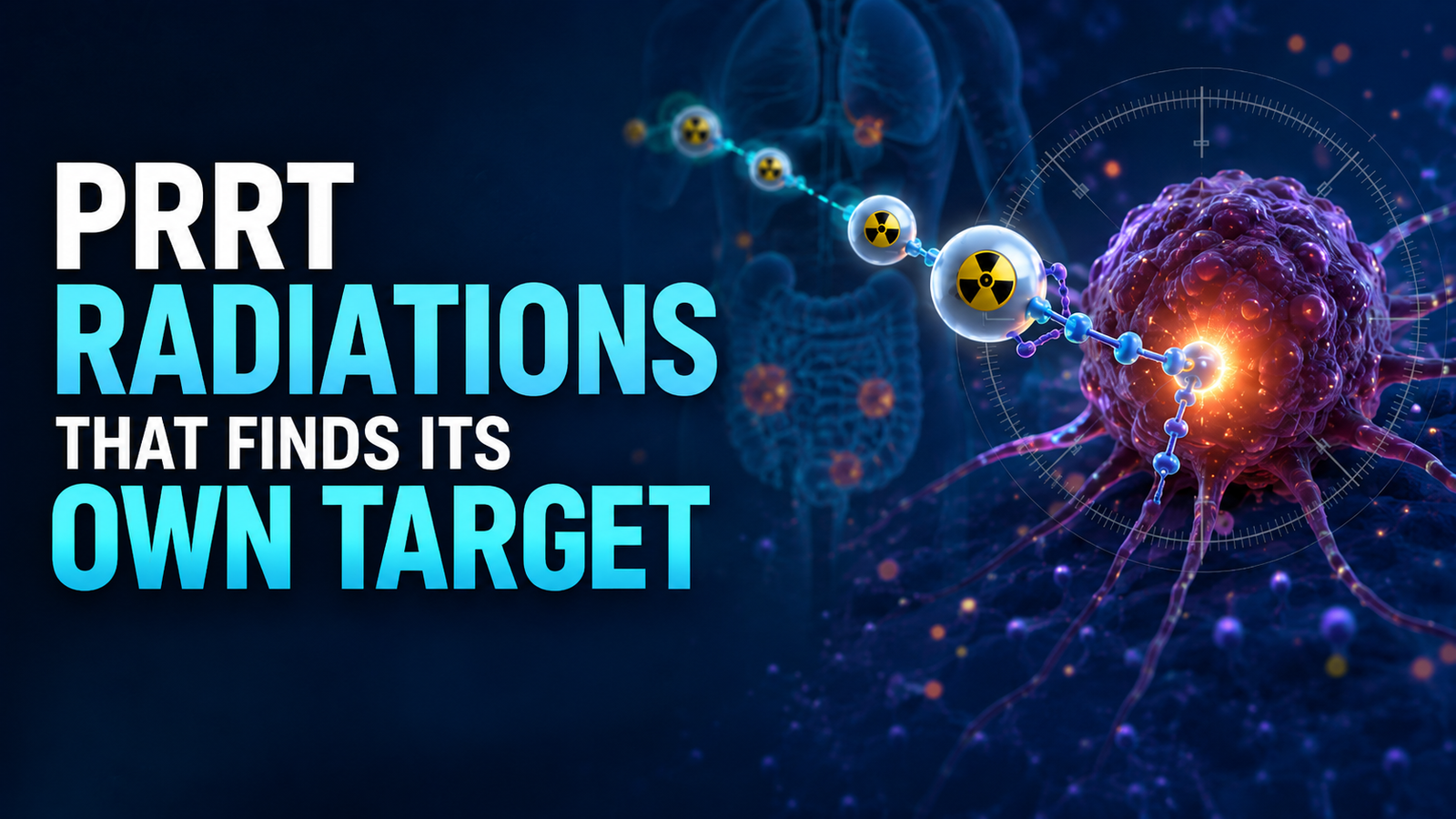
Most radiation is aimed at a Tumour from outside the body. PRRT works the other way round. A radioactive medicine is given through a drip, and the Tumour cells pull it in themselves.
PRRT stands for Peptide Receptor Radionuclide Therapy. The medicine most often used is Lutetium-177 DOTATATE. It works for one family of tumours only: Neuroendocrine tumours (NETs) of the Stomach, intestine and Pancreas.
How it works: a lock, a key and a payload
- The lock: many NETs carry a receptor on their surface called the somatostatin receptor.
- The key: DOTATATE, a man-made copy of a natural hormone, fits this receptor.
- The payload: a radioactive atom, Lutetium-177, rides on the key.
The radiation travels only about 2 mm, so most of the damage stays inside the Tumour that took the medicine in.
A scan decides first
Before treatment, you have a special PET-ct scan (Ga-68 DOTATATE PET-CT). It uses the same key with a harmless tracer. If the Tumour lights up brightly, PRRT can reach it. If it does not light up, PRRT will not work.
Does it work?
Yes, for the right patient. In large international trials, PRRT kept tumours under control for roughly 10 to 14 months longer than standard medicines. The Tumour shrank in some patients. In most, it simply stopped growing.
What we do not yet know for certain is whether it helps people live longer. Studies are still following patients to answer this.
Who may benefit
People with a NET that cannot be removed by surgery or has spread, often to the liver
Whose Tumour lights up on the PET scan
Whose blood counts and kidneys are healthy enough
PRRT is not a treatment for the common type of Pancreatic cancer (adenocarcinoma). That is a different disease.
What to expect
Four doses, given through a drip, about 8 weeks apart
A separate drip of amino acids with each dose, to protect the kidneys
Regular blood tests between doses
Simple radiation precautions at home for a short time, which the team explains
Side effects
Most people manage well. Nausea and tiredness are common in the first days. Blood counts can drop and are watched closely. Rarely, a bone marrow problem can develop years later, in about 1 to 2 people in 100. This is the main long-term risk, and it is weighed carefully before treatment.
PRRT and surgery
They do different jobs. If a NET can be removed completely, surgery is usually the first choice. PRRT treats disease that surgery cannot clear. Many patients receive both at different stages.
The best plan comes from a team: surgeons, oncologists, nuclear medicine specialists and radiologists looking at the same scans together.
Frequently Asked Questions
No. It is a targeted radioactive medicine that attaches to a receptor on Tumour cells.
No. It works only for Neuroendocrine tumours that light up on the pet scan. It is not used for the common type of Pancreatic cancer (adenocarcinoma).
No operation is involved. It is given through a drip, like a saline infusion.
Usually four, about 8 weeks apart. Your team decides the exact plan.
Usually not. In most patients PRRT stops the Tumour from growing for a long time, and in some it shrinks.
It is an approved, well-studied treatment. The main risks are low blood counts and, rarely, a bone marrow problem later on. Careful selection and regular blood tests keep these risks low.
PRRT is a well-tested, targeted treatment for Neuroendocrine tumours that cannot be removed. A scan decides whether it is possible. A team decides whether it is right for you.
Medical disclaimer: This article is for general education and does not replace a consultation with your doctor.