Pancreatic Cancer: Awareness, Early Detection and Where the Real Hope Is
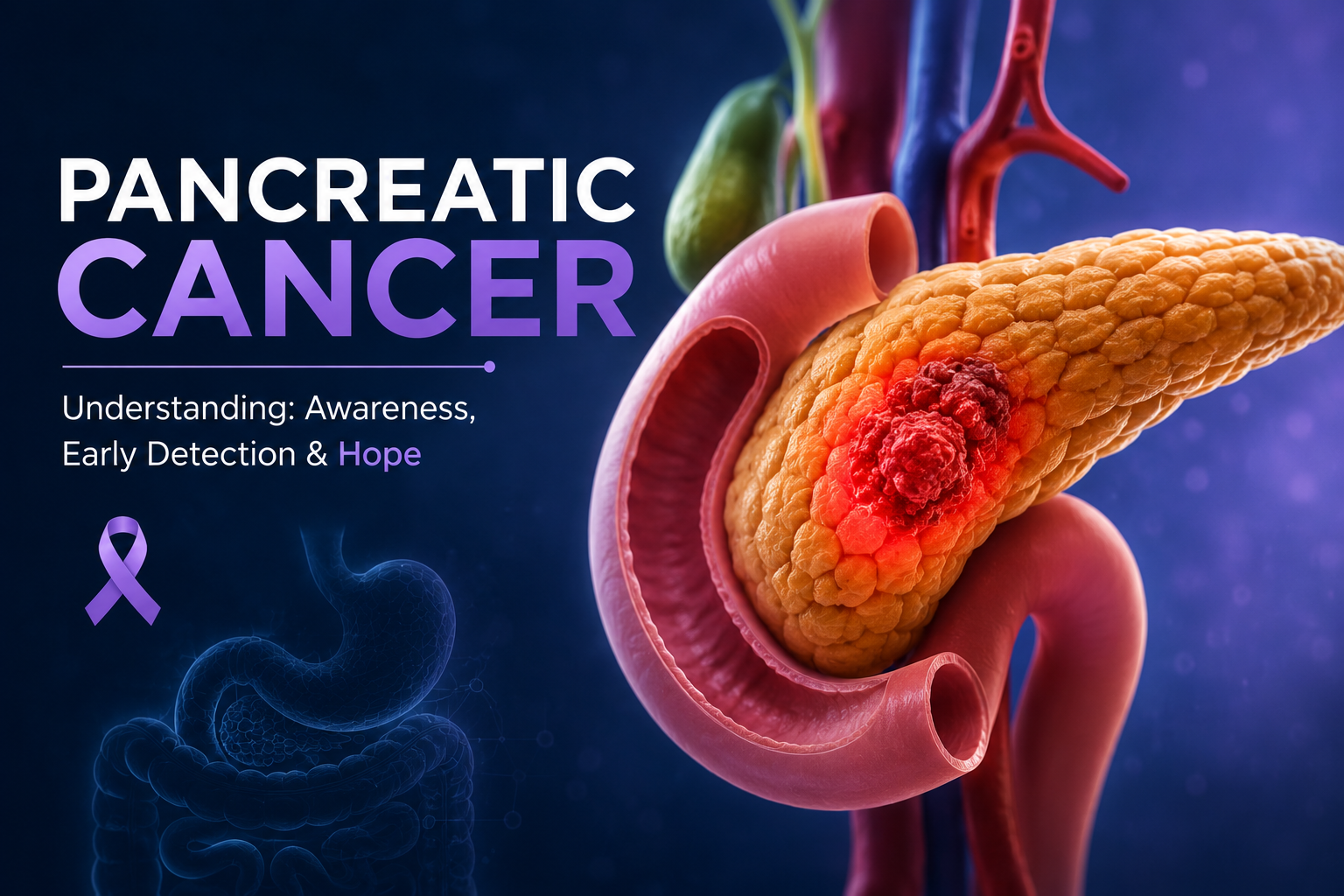


November is Pancreatic cancer Awareness Month. The colour is purple, and if you have seen the ribbon this month, you have probably also seen the statistic attached to it: Pancreatic cancer is among the deadliest of the common cancers, and it is one of the very few whose death rate has not moved in step with the rest of cancer care.
That statistic deserves context rather than fear. Pancreatic cancer is hard to find early, but not impossible. It is difficult to treat, but not uniformly so. And the things that genuinely change a person's odds — not smoking, taking new-onset diabetes seriously after fifty, knowing your family history, and acting on persistent symptoms rather than waiting them out — are not exotic. They are ordinary actions taken at the right moment.
This article covers what the disease actually is, why it presents late, which risk factors are real versus overstated, who should genuinely be under surveillance, and where hope currently sits. If you read one section, read the last one.
What Pancreatic cancer actually is
The Pancreas is a gland that sits deep in the abdomen, behind the Stomach, curving around the Duodenum. It does two jobs: it produces digestive enzymes, and it produces hormones, including insulin. Its location is the reason this cancer behaves the way it does. Tucked against the spine, the major blood vessels, the Bile duct and the small bowel, a Tumour here can grow for a long time without touching anything that produces a symptom.
About 90% of Pancreatic cancers are ductal adenocarcinomas — cancers arising from the cells lining the Pancreatic duct. The remaining small share are Neuroendocrine tumours of the Pancreas, which behave differently, grow at different speeds and are managed on separate pathways. When this article says Pancreatic cancer, it means the common exocrine type unless stated otherwise.
Most tumours arise in the head of the Pancreas, which is why painless Jaundice is such a classic presentation: the head sits against the Bile duct, and a growing mass there blocks bile flow early. Tumours of the body and tail grow silently for longer and are more often found at a later stage.
Why it is found late
The honest answer has three parts.
First, there is no early symptom. The Pancreas has no lining that reports pain the way the gut does, and the organ's deep position means discomfort appears only when a Tumour has grown enough to reach nerves or structures behind it — which is frequently a late event.
Second, the early symptoms that do exist are generic. Mild upper abdominal discomfort, a change in appetite, a little nausea, unexplained weight loss: these are the symptoms of dozens of common conditions. Both patients and clinicians reasonably look at common causes first.
Third, there is no Screening test for the general population. Unlike breast, cervical or Colorectal cancer, there is no established population programme that detects Pancreatic cancer before symptoms, because the disease is not common enough in the general population for a scan-and-blood-test strategy to do more good than harm.
The result is that roughly half of cases are diagnosed after the cancer has already spread, and overall five-year survival in India remains in the single digits to low teens. The stage split is stark: in United States data, five-year survival is around 45% when the disease is caught confined to the Pancreas, but under 5% when it has distant disease. That gap is the entire argument for awareness — not early detection as a slogan, but early detection as the single variable that most changes an individual outcome.
The risk factors that are real
Some widely circulated claims about Pancreatic cancer risk are weak. The factors below are the ones with consistent evidence behind them.
Smoking
Smoking is the single largest modifiable risk factor, accounting for roughly one in five to one in four cases. The risk falls after quitting, though it does not immediately return to that of a never-smoker. If there is one action on this list with the clearest evidence behind it, it is this one. Tobacco causes roughly a doubling of risk, and cigar and pipe smoking carry similar increases.
New-onset diabetes after age 50
Most people know that diabetes can be a consequence of Pancreatic cancer. Far fewer know that new diabetes appearing after about age 50 — particularly alongside weight loss or changing appetite — can be an early sign of the cancer itself, appearing months before a mass is visible on imaging. The relationship runs both ways, and clinicians are increasingly taught to treat new late-life diabetes as a signal rather than a routine finding. If you are over 50 and newly diagnosed with diabetes, report unexplained weight loss or persistent abdominal symptoms promptly rather than assuming they belong to the diabetes.
chronic pancreatitis
pancreas repeatedly inflamed and scarred over years carries an elevated risk, particularly when the inflammation is longstanding and alcohol-related. Most episodes of Acute Pancreatitis do not translate into cancer risk; it is the chronic, recurring form that matters.
Family history and inherited conditions
Between 5% and 10% of Pancreatic cancers arise in people with an inherited predisposition. Well-established genes include BRCA2, PALB2, CDKN2A (the gene behind familial atypical multiple mole melanoma syndrome), Lynch syndrome and Peutz-Jeghers syndrome. Two or more relatives with Pancreatic cancer on the same side of the family, or a first-degree relative diagnosed young, is the practical threshold at which a person should discuss referral to a genetics-aware Pancreatic surveillance programme rather than generic Screening advice.
If this applies to you, it is the single most actionable piece of information in this article. Surveillance programmes for high-risk individuals — typically annual MRI or MRCP combined with endoscopic ultrasound starting around age 50, or a decade before the earliest diagnosis in the family — detect cancers at a Resectable stage far more often than symptom-driven diagnosis does.
Obesity, alcohol and age
Excess weight and physical inactivity are associated with a modestly increased risk, consistent with their profile across many cancers. Alcohol raises risk mainly through Chronic Pancreatitis rather than directly. And risk rises with age: the median age at diagnosis in Western registries is around 70, though Indian series report a younger age distribution, which is one reason the disease weighs so heavily here.
Symptoms that deserve attention
No single symptom diagnoses Pancreatic cancer, and having one of these does not mean you have it. The reason to know them is that combinations, persistence and change matter:
- Painless Jaundice: Yellowing of the eyes or skin without itch or pain, often with dark urine and pale stools. This is the classic presentation of a head-of-Pancreas tumour and always warrants imaging.
- Deep abdominal or back pain: A gnawing ache felt through to the back, often worse after eating or when lying flat.
- Unexplained weight loss: Losing weight without dieting, especially with reduced appetite.
- New or changing diabetes: Particularly over age 50, or a known diabetes that suddenly becomes difficult to control.
- Digestive changes: New nausea, bloating, oily stools that float, or intolerance of fatty foods.
- Unusual clotting: A first-time deep vein thrombosis or pulmonary embolism without an obvious cause can, rarely, be the first sign.
The practical rule: symptoms that persist beyond two to three weeks without explanation deserve a doctor's assessment rather than another month of waiting. For a fuller walkthrough of symptom patterns, the site's dedicated symptoms article covers them in detail.
Is there a Screening test?
For the general population, no — and this is a considered position, not a neglect. The disease is too uncommon in average-risk people for routine scanning to be net beneficial. CA 19-9, the Tumour marker most often asked about, is not a Screening test: it rises in many benign Liver and biliary conditions and can be normal in Pancreatic cancer even when the disease is present. It is used to monitor known disease, not to find it.
Surveillance is different from Screening, and this is where the distinction matters. People at genuinely high risk — defined genetic syndromes, strong family history, hereditary Pancreatitis — are candidates for structured surveillance in a specialist programme, not for opportunistic scans. The consensus approach from the international Pancreatic cancer surveillance groups is annual MRI/MRCP plus endoscopic ultrasound, beginning around age 50 or ten years before the earliest affected relative, adjusted for the specific gene involved.
If you are unsure whether your family history qualifies, the fastest route is not a scan — it is a genetics referral. A clear family pedigree determines who belongs in a programme, and getting that assessed once is more valuable than years of ambiguous advice.
Where early detection and treatment are actually improving
Hope in Pancreatic cancer is not a matter of optimism; it is a matter of measurable movement in specific areas.
Stage at diagnosis remains dominant, but more tumours are now being brought into surgical reach than before. Neoadjuvant Chemotherapy — treatment given before surgery — shrinks borderline tumours and clears micrometastatic disease, so that a higher proportion of those taken to the operating room have genuinely favourable biology. A Tumour that would have been called inoperable five years ago is now frequently treated first and operated on later, if the response is good.
Systemic therapy has improved. The combination regimens FOLFIRINOX and gemcitabine plus nab-paclitaxel both extended survival over the older single-agent standard, and they remain the backbone of advanced treatment. Marker-based therapy now changes real decisions: mismatch-repair deficiency responds to Immunotherapy, and BRCA or PALB2-mutated tumours are increasingly treated with platinum Chemotherapy and maintained with PARP inhibitors.
Detection technology is quietly getting better as well. endoscopic ultrasound places a high-resolution probe millimetres from the Pancreas, and it finds small lesions that CT can miss. Blood-based tests combining multiple markers with machine-learning models are in active validation for high-risk groups — not ready for general use, but no longer theoretical.
And outcome data, while still sobering, are trending the right way: population-level survival for Pancreatic cancer has been rising slowly but consistently in registry data over the past decade, driven by better surgery, better regimens and a small but real increase in the proportion caught early.
How Pancreatic cancer is treated
Treatment is decided by a multidisciplinary team — surgeon, medical oncologist, radiation oncologist, radiologist and pathology — and depends on stage, the tumour's relationship to major blood vessels, the patient's fitness and the tumour's molecular markers.
- Surgery: The whipple procedure (pancreaticoduodenectomy) for tumours in the head, and Distal pancreatectomy for tumours of the body and tail. Surgery offers the only realistic chance of cure, and it is only possible when the disease is confined and the blood vessels are free or manageable. Outcomes are strongly volume-dependent — outcomes improve at higher-volume centres.
- chemotherapy: FOLFIRINOX or gemcitabine plus nab-paclitaxel in advanced disease, and increasingly before or after surgery in Resectable and borderline disease.
- Radiation: Used selectively — for locally confined disease that cannot be removed, or after surgery in selected high-risk patterns.
- Targeted and immune therapy: Reserved for marker-defined subgroups: Immunotherapy for MSI-high tumours, PARP inhibition for BRCA-mutated disease, and other targeted options as profiling expands.
- Supportive and Palliative care: Introduced early, alongside treatment rather than after it. Good Palliative care measurably improves quality of life and, in several cancers, survival — it is not a last resort.
What actually helps — this month and any month
If you take one action from this article, let it be the first one.
- If you smoke, stop. This is the highest-yield single change available for Pancreatic cancer and for a long list of others.
- Know your family history. Two or more relatives with Pancreatic cancer, melanoma, breast, ovarian or bowel cancer on one side of the family is a reason to ask for a genetics referral — not for a scan.
- Take new-onset diabetes after 50 seriously. Report unexplained weight loss or persistent abdominal symptoms to your doctor rather than waiting for the next appointment.
- Maintain a healthy weight and stay physically active. Modest effect, but real and entirely within your control.
- Keep alcohol moderate, and know that heavy drinking acts through the Pancreas as well as the Liver.
- Act on persistence. Jaundice, back pain, weight loss or digestive change lasting beyond two to three weeks without explanation deserves assessment, not patience.
- If you are living with a diagnosis, ask about biomarker testing and whether a clinical trial is an option. Molecular profiling is now part of standard care, and trial eligibility is broader than most patients realise.
Awareness months are useful for exactly one reason: they convert an abstract statistic into a specific action somebody takes that week — a phone call about family history, an appointment about Jaundice that has not cleared, a quit attempt that finally sticks. The purple ribbon matters only if it changes something on that list.
References
Sources consulted for this article.
Bray F, Laversanne M, Sung H, et al. Global cancer statistics 2022: GLOBOCAN estimates of incidence and mortality worldwide. CA Cancer J Clin. 2024;74(3):229-263.
doi:10.3322/caac.21834
American Cancer Society. Key Statistics for Pancreatic Cancer. https://www.cancer.org/cancer/types/pancreatic-cancer/about/key-statistics.html
Rawla P, Sunkara T, Gaduputi V. Epidemiology of pancreatic cancer: global trends, etiology and risk factors. World J Gastrointest Oncol. 2019;11(6):473-487.
doi:10.4251/wjgo.v11.i6.473
Goggins M, Overbeek KA, Brand R, et al. Management of patients with increased risk for familial pancreatic cancer: updated recommendations from the International Cancer of the Pancreas Screening (CAPS) Consortium. Gut. 2020;69(1):7-17.
doi:10.1136/gutjnl-2019-319352
Chari ST, Leibson CL, Rabe KG, et al. Probability of pancreatic cancer following diabetes: a population-based study. Gastroenterology. 2005;129(2):504-511.
doi:10.1053/j.gastro.2005.04.031
Iodice S, Gandini S, Lohr M, Lowenfels AB, Maisonneuve P. Tobacco and the risk of pancreatic cancer: a review and meta-analysis. Ann Oncol. 2008;19(4):520-526.
doi:10.1093/annonc/mdm541
Conroy T, Desseigne F, Ychou M, et al. FOLFIRINOX versus gemcitabine for metastatic pancreatic cancer. N Engl J Med. 2011;364(21):2014-2022.
doi:10.1056/NEJMoa1011923
Von Hoff DD, Ervin T, Arena FP, et al. Increased survival in pancreatic cancer with nab-paclitaxel plus gemcitabine. N Engl J Med. 2013;369(18):1691-1703.
doi:10.1056/NEJMoa1304369
National Cancer Institute. Pancreatic Cancer Treatment (PDQ) – Patient Version. https://www.cancer.gov/types/pancreatic/hp/pancreatic-treatment-pdq
Pancreatic Cancer Action Network. World Pancreatic Cancer Day and early detection initiatives. https://www.pancan.org
Frequently Asked Questions
No. That reputation comes from the fact that most cases are found late, not from an absence of effective treatment. When the cancer is caught confined to the Pancreas, five-year survival is around 45% in modern series, and surgery with Chemotherapy can be curative. Even in advanced disease, treatment can control it for meaningful periods, and outcomes continue to improve with better regimens and marker-based therapy.
Not the general population — there is no Screening test proven to benefit average-risk people. People with strong family history, known inherited syndromes such as BRCA2, PALB2, CDKN2A, Lynch syndrome or Peutz-Jeghers, or hereditary Pancreatitis should be referred to a specialist surveillance programme, usually starting around age 50 or ten years before the earliest family diagnosis.
Not completely, but risk is genuinely reducible. Not smoking is the strongest single step. Maintaining a healthy weight, keeping alcohol moderate, managing diabetes, and staying physically active all lower risk. Nothing eliminates it, and people with high-risk family history should discuss surveillance rather than relying on prevention alone.
Painless yellowing of the eyes or skin, unexplained weight loss, a deep abdominal or back ache that persists, new diabetes after age 50, and ongoing digestive change — especially oily, floating stools. The common thread is persistence: symptoms lasting beyond two to three weeks without explanation warrant medical assessment.
Yes. November is Pancreatic cancer Awareness Month, marked by the purple ribbon, with World Pancreatic cancer Day observed on the third Thursday of November. Its purpose is to shift the conversation from the mortality statistic alone to the actionable parts: risk reduction, symptom awareness, family-history assessment and progress in early detection.