Gallbladder biopsy finds cancer after removal
(Incidental Gallbladder Cancer)


Table of contents
Gallbladder biopsy after removal
Gallbladder biopsy (also called histopathology) is the routine microscopic examination of the gallbladder after it has been removed during surgery. After gallbladder removal surgery (cholecystectomy), the entire gallbladder is sent to a pathology laboratory, where a pathologist examines it under a microscope. The biopsy report usually takes about 1-2 weeks and will state whether the gallbladder is normal or has changes of inflammation, polyps, precancerous changes or cancer.
Gallbladder cancer detected in biopsy
Gallstones are a common problem. Many people suffering from gallstones undergoes gallbladder removal surgery, a laparoscopic cholecystectomy. The gallbladder along with stones is removed in this surgery. In one to two out of a hundred such patients, the biopsy of the gallbladder will show the presence of cancer. This condition is called incidental gallbladder cancer.
1-2% of gallstone cholecystectomies reveal cancer
Gallbladder cancer is one of the most aggressive cancers of the gastrointestinal tract. India has the highest rate of occurrence of this disease in the world. Women are three times more likely to develop gallbladder cancer compared to men.
The initial diagnosis may come as a shock, but proper planning and treatment are crucial for good outcomes.
Staging of incidental gallbladder cancer
As in other cancers, staging is important here. Staging for incidental gallbladder cancer is the same as gallbladder cancer and follows the TNM (Tumour, Node and Metastasis) classification developed by the American Joint Committee on Cancer (AJCC).
- The extent (size) of the tumour (T): How far has cancer grown into the layers of the gallbladder wall? Has cancer reached nearby structures or organs?
- The spread to nearby lymph nodes (N): Has cancer spread to nearby lymph nodes? And to how many?
- The spread (metastasis) to distant sites (M): Has cancer spread to distant lymph nodes or distant organs such as the liver or lungs?
Since we already have the removed gallbladder, the pathologist will tell us the exact T stage. For the rest, we need to do an imaging test such as a CT scan, PET-CT scan or MRI. This will tell us if there are any enlarged lymph nodes or metastasis (spread to other organs). We also check for tumour marker CA 19.9.
T stage is classified into T1, T2, T3 and T4. T1 is further subclassified into T1a and T1b.
Treatment of incidental gallbladder cancer
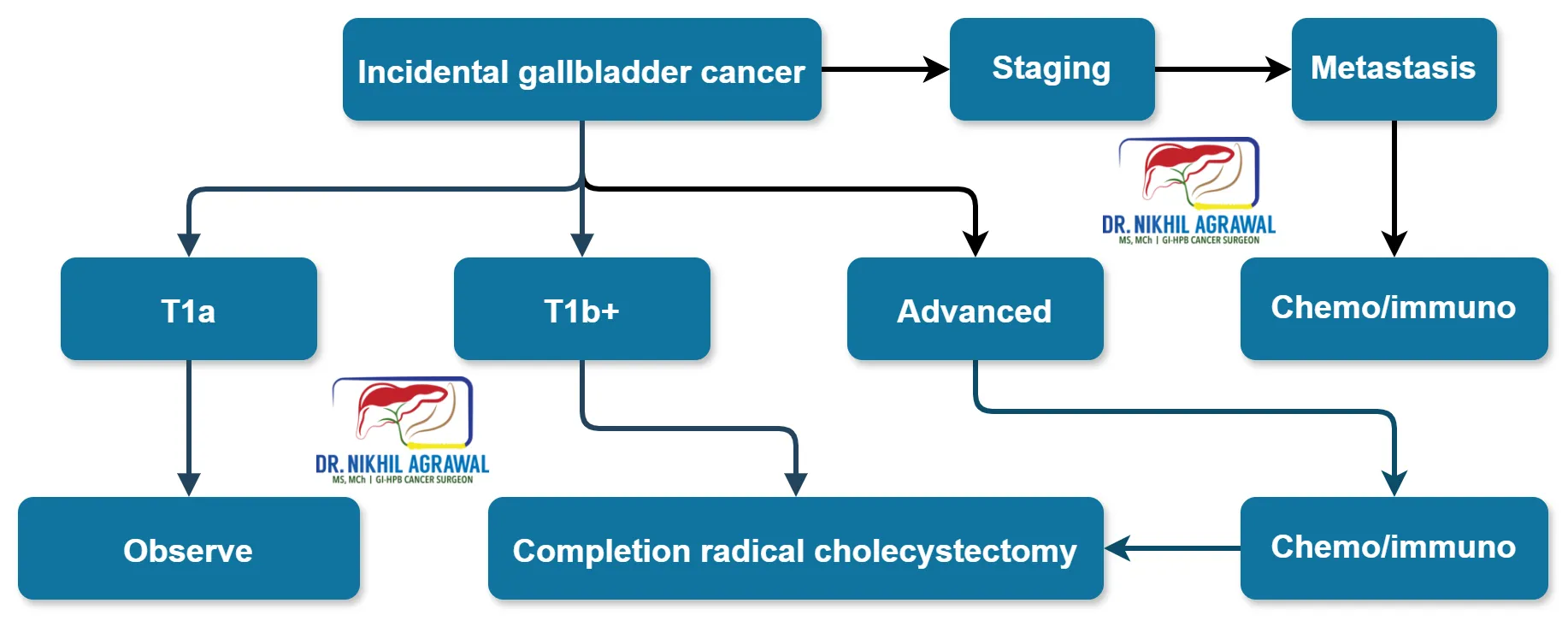
Treatment of any cancer depends on the stage. In incidental gallbladder cancer, if the imaging test does not find large lymph nodes or metastasis elsewhere then treatment is based on pathological T stage. Patients with T1a disease rarely require surgery and are only observed. Those with T1b and beyond should undergo surgery.
Before planning treatment, some additional information is also required such as surgical approach, cystic duct margin, whether there was any GB perforation and bile spillage and how and through which port gallbladder was removed.
If the T stage is advanced or imaging tests show large nearby lymph nodes, then we usually give few cycles of chemotherapy before surgery. If it shows spread to distant organs, then we should confirm it with a biopsy and treat it with chemotherapy and immunotherapy.
Surgery for incidental gallbladder cancer
Completion radical cholecystectomy
Surgery for cancer entails the removal of the diseased organ along with adjacent healthy tissue and lymph nodes. Gallbladder cancer surgery is radical cholecystectomy or extended cholecystectomy. Surgery for incidental gallbladder cancer is completion radical cholecystectomy or extended cholecystectomy.
The gallbladder is attached to the undersurface of the liver. When a surgeon operates for gallstones, he stays very close to the gallbladder. The liver surrounding the gallbladder and adjacent lymph nodes are not removed. In radical cholecystectomy, we remove the gallbladder along with adequate removal of its liver bed to the healthy tissue. The lymph nodes in the vicinity are also removed.
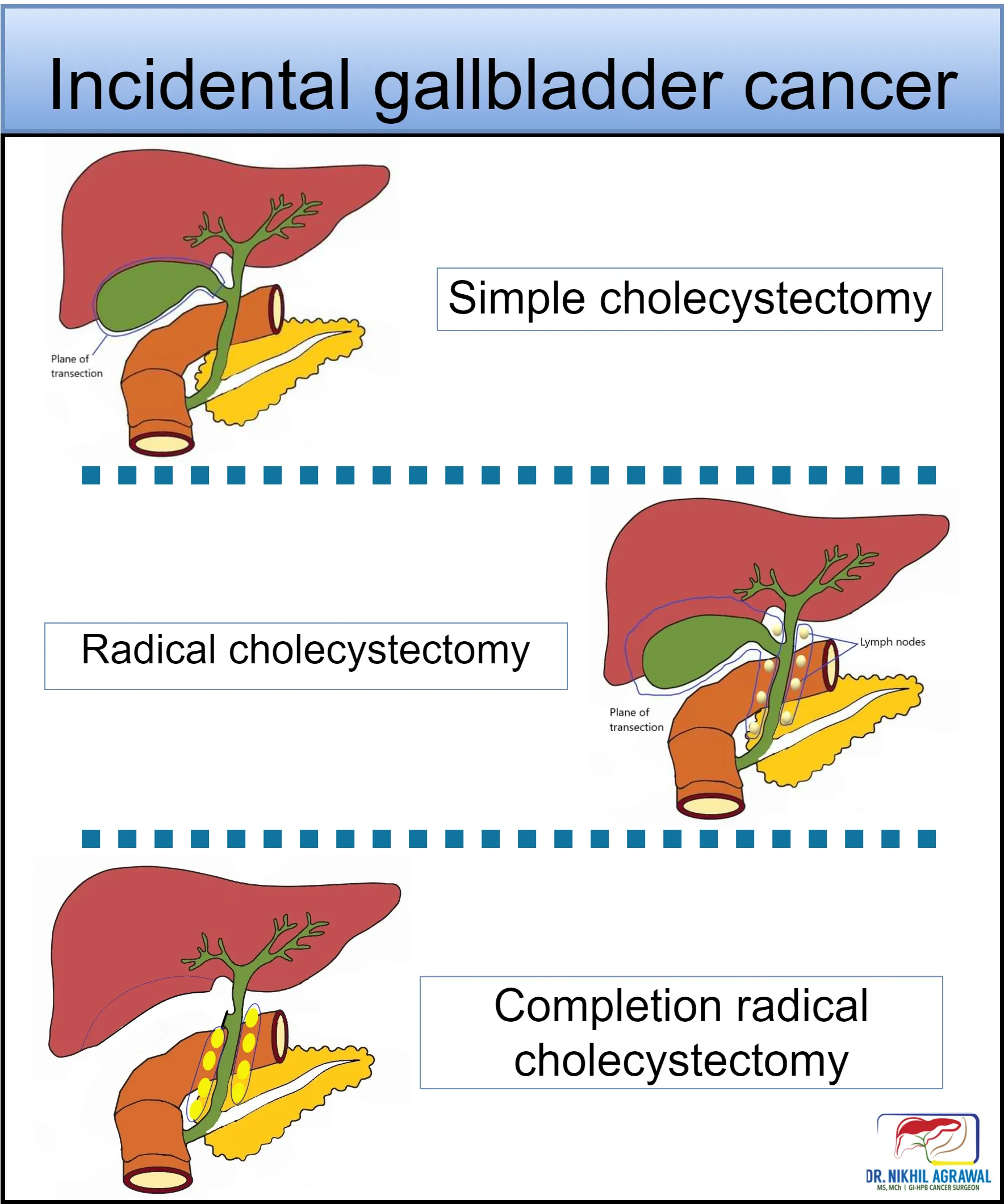
Types of gallbladder surgeries | Completion radical cholecystectomy
In incidental gallbladder cancer, since the gallbladder is already removed, the liver around the gallbladder bed and lymph nodes are removed. Sometimes, we also need to remove the bile duct and the laparoscopic port sites.
Robotic completion radical cholecystectomy
Robotic surgery combines a surgeon's expertise with the vision and precision of advanced robotic technology. The system includes a 3D high-definition camera for enhanced vision, a surgical console for the surgeon and robotic arms with instruments that provide stability and can manoeuvre in ways the human hand cannot, making it easier to operate in confined spaces.
Compared to open surgery, the benefits of robotic surgery include smaller incisions, less blood loss, decreased postoperative pain, shorter hospital stays, and faster recovery times. Patients who undergo robotic completion radical cholecystectomy often experience a quicker return to their daily activities and improved overall quality of life.
Comparison of open and robotic surgery
| Open Surgery | Robotic Surgery (Our Series) | |
|---|---|---|
| Lymph nodes removed | 6-10 | 14 (better) |
| Hospital stay (days) | 6-8 | 4 (shorter) |
Frequently Asked Questions

About Author
Dr. Nikhil Agrawal
MS, MCh
Dr. Nikhil Agrawal is a leading GI-HPB Surgical Oncologist with 20+ years of experience in complex cancers of the esophagus, stomach, colon, rectum, liver, pancreas, gallbladder, and bile ducts. He leads the GI-HPB Oncology Program at Apollo Hospitals, Delhi and Gurugram, with expertise in advanced robotic and laparoscopic cancer surgery.
His practice focuses on evidence-based, multidisciplinary care with an emphasis on individualized treatment and long-term outcomes.
He trained at BHU, SGPGI Lucknow, AIIMS New Delhi, and SNUBH, South Korea, and is a robotic surgery proctor who trains surgeons in advanced GI-HPB cancer surgery. He is also regularly invited as faculty at national and international scientific meetings.
This website helps patients and families understand GI and HPB diseases and cancers, treatment options, and what to expect during recovery and long-term care.