Fibre: what the research actually supports, and what it does not
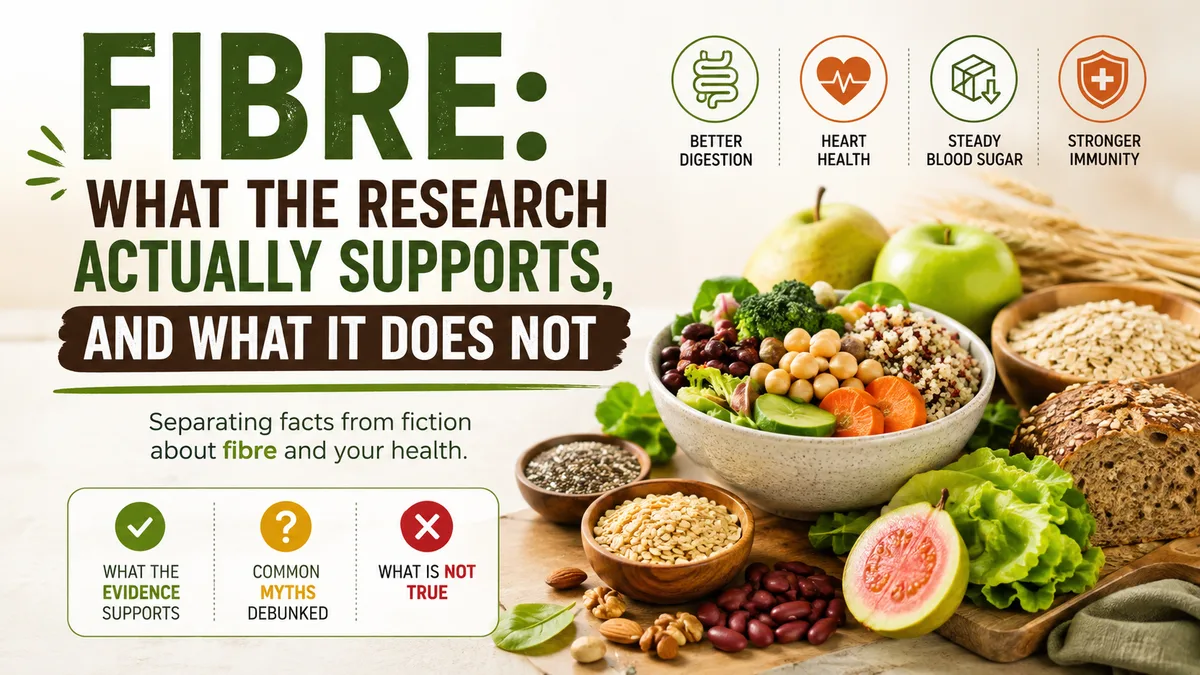


Fibre is having its moment online. "Fibermaxxing" has taken over the feeds that were talking about protein a year ago. Most of what gets shared is roughly right; some of it is not. Let's separate the two.
You do not digest fibre. Your bacteria do
Fibre is the one part of food your enzymes cannot break down. It reaches your Colon intact, where trillions of bacteria ferment it. That fermentation produces short-chain fatty acids, mainly butyrate, acetate, and propionate. Butyrate is the main fuel for the cells lining your Colon.
So the simple arrangement is: you feed the bacteria, and the bacteria provide nutrition to the gut wall.
What happens when you stop feeding them? In an experiment where mice were given human gut bacteria and then put on a low-fibre diet, the bacteria started eating the mucus layer, thinning the protective barrier.
Fibre is not one thing. It does three different jobs
Three types of fibre do three different things, and we require all of them.
Bulking fibre holds water, adds weight to stool, and speeds transit; sources include wheat bran, whole wheat roti, vegetables, and salads.
Viscous fibre forms a gel; it binds bile acids, lowers LDL cholesterol, and slows the sugar rise after a meal. Sources include oats, barley, rajma, chana, isabgol, apple, and guava.
Fermentable fibre is what your bacteria actually eat; sources include dal, onion, garlic, banana, and millets.
A mixed diet gives you all three, whereas a single supplement gives you one.
What the evidence supports
A large synthesis of 185 observational studies and 58 trials found that people eating the most fibre had roughly 15 to 30 percent lower rates of death from any cause, coronary heart disease, stroke, type 2 diabetes and Colorectal cancer than those eating the least. The benefit appeared to peak somewhere around 25 to 30 grams a day. Alongside this, the trials showed lower body weight, blood pressure and total cholesterol. The authors graded the certainty as moderate, which is honest and appropriate.
For Colorectal cancer specifically, the World Cancer Research Fund's 2018 review classifies wholegrains and fibre-containing foods as probably protective.
The finding I find most useful in clinic comes from patients who already have the disease. Among 1,575 people with stage I to III Colorectal cancer followed for a median of eight years, each additional 5 grams of daily fibre after
Patients who increased their intake after diagnosis had better survival. In the study, each 5-gram-per-day increase in fibre intake was associated with an 18 percent lower risk of Colorectal cancer-specific mortality.
What is not true
Powders are not a shortcut. Trials of fibre supplements for preventing the return of colon Polyps were negative. Supplements do have real uses. Psyllium, or isabgol, meaningfully lowers LDL cholesterol in randomised trials. But a supplement is a narrow tool, not a substitute for the diet.
Personalised fibre by microbiome is not ready. It is a real research direction. It is not clinical advice today.
What to actually do
The WHO recommends at least 25 grams of naturally occurring fibre a day for adults, from food rather than supplements. Most people fall well short of it.
Practically, that means dal or rajma or chana most days, whole grains and millets instead of refined flour, vegetables at both main meals, fruit with the skin on, and a handful of nuts or seeds.
Two cautions. Increase slowly over two to three weeks, because a sudden jump causes bloating and gas that makes most people quit. And if you have inflammatory bowel disease, a stricture, or significant irritable bowel symptoms, the right amount and type of fibre is not the same for you, so discuss it before making changes.
References
Based on peer-reviewed research and WHO/WCRF guidance.
Reynolds A, Mann J, Cummings J, Winter N, Mete E, Te Morenga LT. Carbohydrate quality and human health: a series of systematic reviews and meta-analyses. Lancet. 2019;393(10170):434-445.
doi:10.1016/S0140-6736(18)31809-9.
Song M, Wu K, Meyerhardt JA, et al. Fiber Intake and Survival After Colorectal Cancer Diagnosis. JAMA Oncol. 2018;4(1):71-79.
doi:10.1001/jamaoncol.2017.3684.
Desai MS, Seekatz AM, Koropatkin NM, et al. A dietary fiber-deprived gut microbiota degrades the colonic mucus barrier and enhances pathogen susceptibility. Cell. 2016;167(5):1339-1353.e21.
doi:10.1016/j.cell.2016.10.043.
Jovanovski E, Yashpal S, Komishon A, et al. Effect of psyllium (Plantago ovata) fiber on LDL cholesterol and alternative lipid targets, non-HDL cholesterol and apolipoprotein B: a systematic review and meta-analysis of randomized controlled trials. Am J Clin Nutr. 2018;108(5):922-932.
doi:10.1093/ajcn/nqy115.
Macrae F. Wheat bran fiber and development of adenomatous polyps: evidence from randomized trials. Am J Med. 1999;106(1A):28S-30S.
World Cancer Research Fund/American Institute for Cancer Research. Diet, Nutrition, Physical Activity and Colorectal Cancer. Continuous Update Project. 2018.
World Health Organization. Carbohydrate intake for adults and children: WHO guideline. 2023. ISBN 978-92-4-007359-3.